How to review your chess games
Going over your own games is the fastest way to get better, and you do not need a coach or a paid account to do it well. Here is a simple way to review, what to look for, and how to make the lessons stick.
Key takeaways
- Your own games are the best study material you have, because the mistakes in them are the ones actually costing you points.
- A good review is active. Pause at the turning points and work out what you missed before you see the answer.
- The move grades, from inaccuracy to blunder, show you where the game turned. Backrank's free game review labels every one.
- Finding a mistake is only half of it. You remember it by bringing the position back later, which is what Backrank does for you.
Most players study with puzzles that have nothing to do with their own games. Your games are different. The mistakes in them are the exact ones costing you rating, which makes going back over them the fastest and cheapest way to improve.
The catch is that reviewing well is a skill of its own. Click through the suggested moves and you learn almost nothing. Slow down and ask the right questions and a single game can teach you more than an hour of random tactics. Here is how to do it well, for free, and how Backrank turns what you find into practice you actually keep.
Backrank free game review
Backrank offers a free game review for Chess.com and Lichess.org players. Paste a game or add your username and it grades every move, no account needed. When you find a mistake, add it straight to your deck and it comes back as a spaced repetition flashcard until the pattern sticks. Try the free game review.
In this article
Why your own games are the best study material
Random puzzles are positions from other people's games, so they train someone else's weaknesses. Your own games are where yours show up. When you keep hanging pieces in the same kind of position, or missing the same tactical idea, your games reveal it long before a generic puzzle set would. Reviewing them turns every loss into a lesson aimed squarely at your weak spots.
It is also free. You do not need a coach or a subscription to see where a game went wrong. You need a way to find the turning points and the patience to understand them, and both are within reach of any player.
How to review a game, step by step
A focused review takes only a few minutes per game. The goal is not to check every move, but to find the handful that actually mattered.
- 1
Load the game
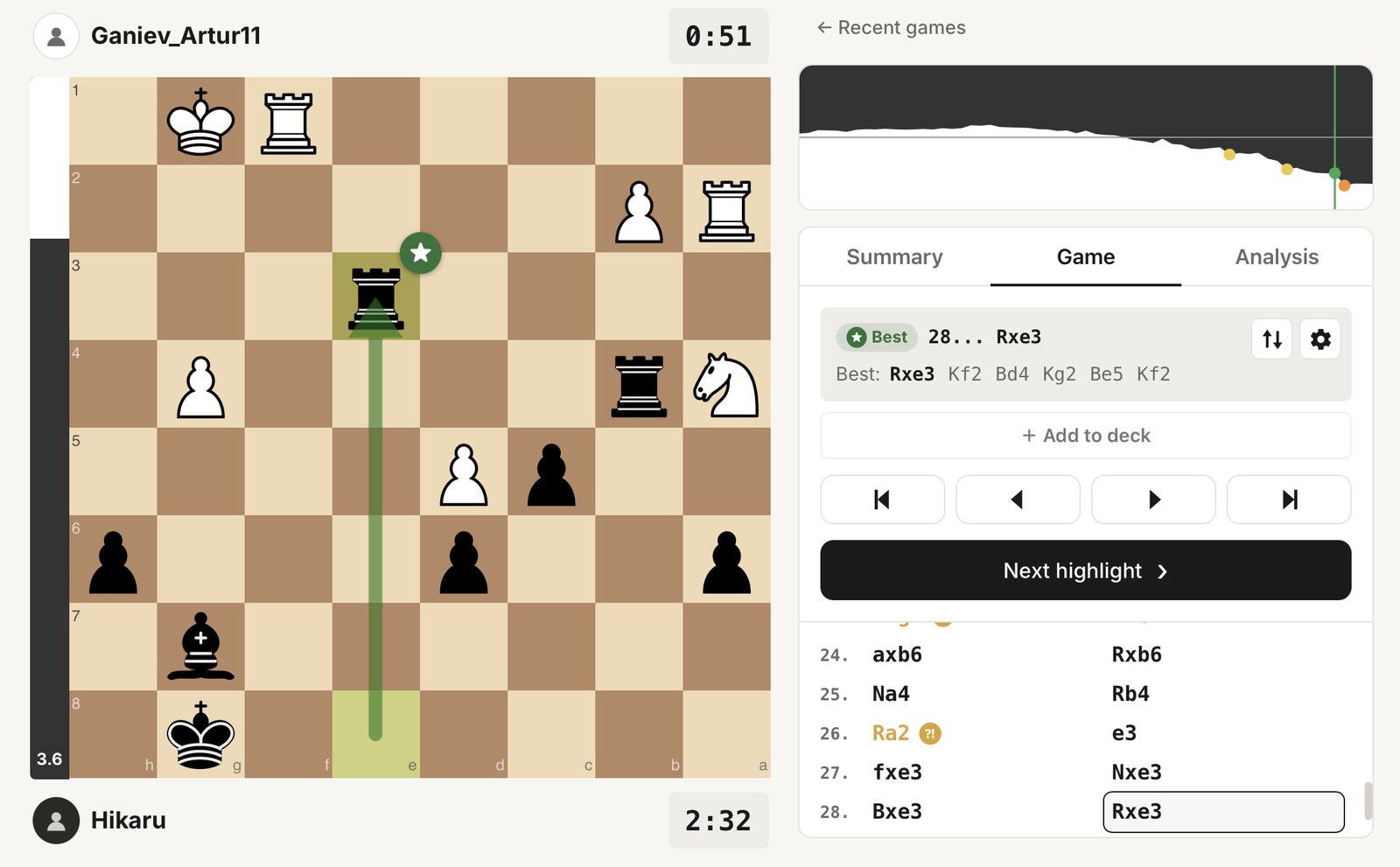
Paste a game or add your Chess.com or Lichess.org username, and Backrank's free game review opens it move by move with an evaluation for every position.
- 2
Find the turning points
Follow the evaluation. The moves where it jumps are where the game was really won or lost, and those are the few positions worth your attention.
- 3
Ask why before you peek
At each turning point, work out what you missed before you look at the suggested move. The honest answer to why it was bad is the actual lesson.
- 4
Keep the mistake
Press Add to deck to save the position, so the pattern comes back to you later as a spaced repetition card. A mistake you understand once and never revisit is one you are likely to repeat.
What the move grades mean
A game review labels each of your moves, so you can see at a glance where things went wrong. The labels are simple, and the bad ones are the ones to study.
The inaccuracies, mistakes, and blunders are your shortlist. A blunder that drops a piece is obvious, but the quiet inaccuracies that slowly hand over a good position are often where the real improvement hides.
Active review beats passive review
How you review matters as much as whether you do it at all. There are two ways to go through a game, and only one of them sticks:
Passive review
Clicking through the suggested moves and nodding along. It feels productive, but the answers go in one ear and out the other.
Active review
Stopping at each turning point to find the move yourself first. The effort of trying to recall it is what burns the pattern in.
The second way is slower, and it is the one that changes your rating. It is also the bridge to real practice, because the mistakes you work through are exactly the ones worth seeing again.
From one review to lasting improvement
Reviewing a game shows you a mistake once. Remembering it is a different problem, and it is the one most players never solve. You spot a blunder on Monday, understand it completely, and walk into the same idea a week later because nothing brought it back.
This is where review and spaced repetition meet. Backrank reviews your recent games, finds every blunder and missed tactic, and turns each one into a flashcard that returns on a schedule, sooner for the mistakes you keep repeating. Your practice ends up built entirely from positions you actually got wrong.
Want to start with a single game? The free game review grades any game move by move, no account needed.
Frequently asked questions
Is reviewing your own chess games worth it?
Yes. Your own games show the exact mistakes costing you rating, which generic puzzles cannot. A few minutes spent understanding where a game turned teaches you more than the same time spent on random tactics.
How do I review a chess game for free?
Open the game in a free game review tool that gives an evaluation for every move, find the points where the evaluation swings, and work out what you missed there. Backrank's free game review does this move by move with no account required.
What should I look for when reviewing a game?
Focus on the turning points rather than every move. Look for the inaccuracies, mistakes, and blunders, ask why each one was bad before checking the suggested move, and watch for the patterns that repeat across your games.
How often should I review my games?
A quick review after each session is plenty for most players. Consistency matters more than depth, since the goal is to notice the mistakes you keep making over many games.
Do I need a chess engine to review my games?
An engine helps by pointing to the moves where the game turned, so you are not guessing. The understanding still has to come from you, but it saves you from missing the moments that mattered.